


;)

Mars Sojourn! Human missions to Mars & Beyond!
As part of preparing for a new life and establishing a new civilization space agencies like SpaceX, NASA and ESA are planning to send Human Missions to Mars in the next 10 to 15 years.
This article will focus on the challenges and opportunities of traveling to Mars, then building habitats down there right from the scratch like solar roads, terraforming towers, drones for delivery, boring machines for underground water, hyperloop tunnels & metals mining and building a temporary track connecting colonies to nearest underground water resource etc.
Traveling to Mars
We have seen the simulations of Starship by SpaceX and some of their experiments. However, I am more impressed with Virgin Galactic spaceship launching method. I want to go a little further and have Nuclear Fission or Fusion Reactor that generates high power electricity that can power a spaceship that zooms to Mars. This has to have a safe approach wherein we are dealing with radioactive materials.
Rocket propellants aren’t too stable. It is taking nth trial for SpaceX to finish testing their Starship module. Don’t know how many more will it take. It is an age-old method. Except that it is a BIG fancy rocket that’s all to it. What I am looking at is an efficient and electrifying flight to Mars.
Terraforming Mars
It is a long and slow continuous process.
So many factors have to work in tandem to make the atmosphere breathable on Martian surface. There are several approaches suggested
like importing ammonia and methane from neighboring planet’s moon Titan to blasting nuclear bombs on Martian polar caps to melt and
release Hydrogen, Oxygen and CO2. However, remember Martian surface is prone to Solar Winds and that’s how it has lost its atmosphere in to space. Hence, building Terraforming towers near the polar ice caps is appropriate and it can be controlled by recycling the air within an allowed radius. As Mars core is not active there is no powerful magnetosphere to divert solar winds from Sun, which needs to be protected from the same. We need to build a magnetosphere dome or a big glass dome that will protect us from UV light and solar winds. In the dome we can have the terraforming towers with recycling plant to maintained the atmospheric density and balancing the air quality just like on Earth. All this has to be accomplished before Humans reach Mars, with the help of AI based Humanoid robots. It can be achieved as it needs to more funding and best research. If not in the next 10 years, we can achieve it next 20 to 30 years.
Let’s continue this pursuit of finding the solutions to live on Mars, at least 70% of how we are doing on Earth.
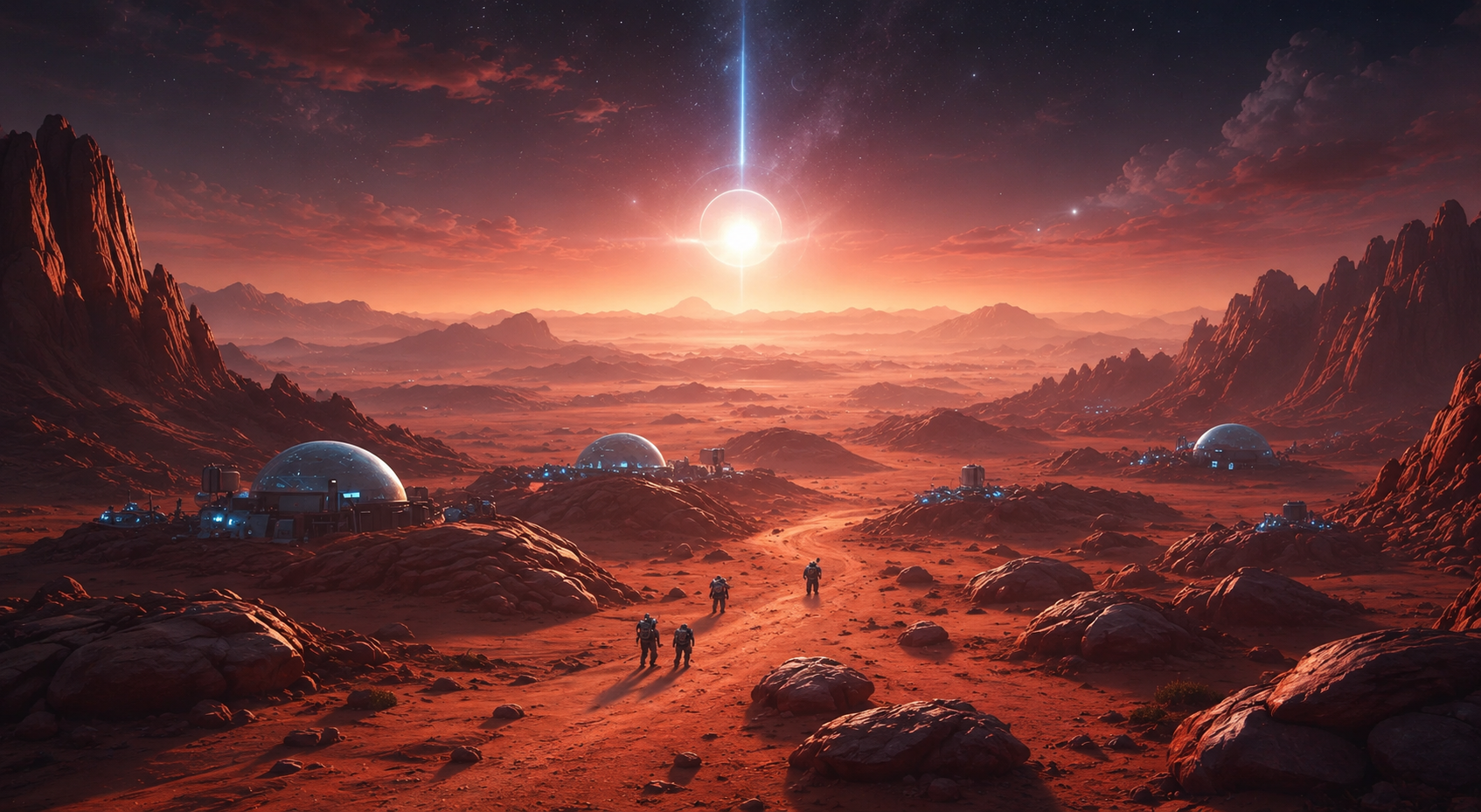
The tallest towers that you see in the pictures are the magnetospheres that will create the continuous magnetic field over the colony which will protect us from interstellar radiation, solar winds that are emanating from our host start Sun and UV light.
Orientation to Earthlings on Mars
I am sure most of the space administrations across the world must be working on this. What makes it alive is Curiosity!
Before we start the journey to Mars, we will have to get educated about long term space travel and impact of zero gravity on the biological adjustment of our bodies to it just like the astronauts on International Space Station. That has to be clearly articulated and well taken care.
Next thing is the orientation once you reach Mars.
How and why?
This will be done based on the data given by the rovers that were sent for the last 20 to 30 years. Mars atmosphere is having just 1% (0.61
kPa (0.088 psi)) of Earth’s pressure and only 38% of the gravity of Earth. And the atmosphere is 96% Co2, Argon 2.1%, Nitrogen 1.9% and Oxygen is 0.145%. So, it is pretty harsh. Definitely the Human population needs to get confine to the designated designed habitats. All dos and don’ts have to be clearly articulated to sustain the Human civilization on Mars. More research and data are required to come up with a concrete agenda on this, which is still evolving.
Living on Mars
Now, we are talking about moving to Mars and that needs long term planning for living quarters. These colonies can be built by AI robots that are sent before the first Human transportation or the first humans will construct it with the help of AI robots. These quarters need to use the local materials and the systems that are taken from the earth like pressure maintenance systems. However, they need to be robust in order to sustain subzero to moderate temperatures on Mars as well the micro dust environment.
We need electricity to survive on Mars and that is the only way to efficiently live on Mars. First choice is Solar based power generators, and the second choice is Nuclear Based Power generators. The concepts are readily available and within next 10 years we should achieve the power generation in these modes. Solar based generation is already happening on ISS, which needs to be extended to Mars. That’s all.
Once the terraforming is done, we can start building family homes Xecoons with all terrain electric vehicle to go around. There can be bars, clubs and senate halls for gathering & entertainment. It would be another great world.
Water Resource on Mars
Exploration of water and transporting it on Mars will be a huge thing.
NASA announced that water exists on Mars on its poles which has ice caps. However, most of it is frozen CO2. We can melt it and produce water from it. Due to the low-pressure atmosphere this water can’t ported through large pipes and it has to be transported using trains
or trucks. It’s very easy to build a train track on Martian surface as it has got less resistance which will be helpful for the faster. There is a need for building a train for water transportation on Mars, which is a special requirement. The habitats that are built are near to polar ice caps will be definitely easy to access the water and the civilization can flourish around it.
Moreover, the Mars has underground water as well, which can be brought out by drilling and sucking the water out of it. More research needs to done on this matter.
Here on Earth the water logistics are going to be a next generation boom as the pure water resources are going to be scarce and the water treatment technologies and transportation (because of low temperatures piping is not an option on Mars) to extra terrestrial will become a new area for science to improve.
Transportation on Mars
Confined to a closed environment can lead to fatigue and psychological effects and syndromes. So, moving around on Mars will be definitely a much-needed activity. This can be achieved in 3 ways – Surface, Aerial and Underground
Surface transportation on Mars
This can be achieved by building Solar roadways and using electric vehicles. We can build solar charging stations on Mars just like on Earth. However, the maintenance of it will be quite challenging as the Mars has micro dust in its atmosphere and those can get into machines and interiors of the equipment. Solar roadways are the ones where the charging can be achieved during daytime and nighttime their edges can be lighted, which displays the route clearly. This will solve half of visibility issues.
Another form of surface transportation is by constructing superconductor railway tracks which are connected to the solar or nuclear reactor produced electric grid. The trains are pressure maintained just like airplane and will have protection from solar or stellar radiation. Also, we can think of building a Hyper-loop as there is already a low-pressure environment on Mars. Then there are vehicles that are built to carry
big machinery like boring machines or mining equipment or pressure maintenance equipment if any Martian habitat has dropped in pressure because of equipment failure. These things need to be thought as we are far away from Earth and immediate help is not at all
easy from Earth.
Underground transportation On
Mars
Connecting habitats with other colonies can be achieved by digging underground tunnels, wherein the temperatures can be maintained easily along with pressure. Because of less air density, building hyper loop kind of concept is achievable along with building underground networks. These can be efficient as there will be less traffic.
Hyper-loop on Mars
Hyper loop concept may be difficult to implement on Earth. But, on Mars it has got perfect conditions to implement it. The track can be built underground which is a low-pressure environment and only the pods need to maintain the pressure. Also, the electromagnetic tracks for levitation are easy to implement as the superconducting materials work efficiently at cryogenic temperatures. The stations for the pods can be built underground as well and can be integrated with the colonies very easily. The advantage of building it underground is better because exposing to to solar and stellar radiation can be completely avoided.
It is quite possible that Hyper-loop may be the best option for travel fast on Mars.
Air transportation on Mars
The size of Mars is about half the size of Earth. Its radius is around 2000+ miles that’s a distance which needs air transportation for quicker coverage.
NASA has flown a helicopter on Martian environment and proved that it can be achieved on thin Martian atmosphere. As Mars has only 38% of Earth’s gravity lift off can be achieved with less power. However, takes more time to create buoyancy for the lift off. This can be achieved by powerful electric jets or thrusters or with cryogenic fuel.
Fun on Mars
As we are on Mars away from crowded Earth, it will be challenging as we will be in smaller groups confined to closed environment that can lead to isolation syndrome. These things can be avoided if we gather at fun places like restaurants and bars. These can be built by clearly
understanding the structural challenges and utilizing Martian extreme cold temperatures to our advantage. The restaurants will grow their own food by using the Greenhouse farming that we use on Earth in a more methodical way. This fresh food will improve the cognitive of
the Martians. We still do not know how the impact of alcohol on Humans on Mars as we have a circadian rhythm synchronization issue as we are far from Earth. Still there can be Bars that can serve some healthy drinks while enjoying games in an environment with music and
dance. This will elevate the spirits of Martians to have fun filled life far from Earth. Cafes can serve food and coffees where Martians can gather for meetings, discussions and entertainment.
Shopping on Mars
As you live in a habitat on Mars which is far from Earth, you still want to emulate some of the things that will keep you happy and forget that you are in isolation. One such thing is shopping. We just need to make it pleasure of doing the same. Research says shopping for groceries once in a week keeps psychologically happy and keeps you away from loneliness. And we will experience that when we are on the Mars in a colony.
There are two options. One going to a grocery store in the habitat under the same roof or two, a drone delivery vehicle will bring the goods that you have ordered.
Building a grocery store and storing it in there is not a big challenge as we don’t need refrigeration that much as we will experience subzero temperatures on Mars. But, keeping it at reasonable temperature we need technology to do it, which we already have it on Earth.
These can be built all by themselves away from habitat, whereas people will come in a pressurized people transporter to these shops.
Healthcare on Mars
We all know that NASA is doing tremendous research on Space Health conditions and challenges of long-term space travel on Human bodies on its ISS. However, the conditions on Mars are little different. Even there they have done lot of progress. Apart from psychological conditions due to isolation and being away from Planet Earth, we at present don’t know the impacts on Humans by living on Mars.
One thing is for sure is fatigue from entering and leaving the pressurized habitats or colonies, demand for hydration as Mars doesn’t have any humidity, inner ear problems due to the pressure differences while traveling between the colonies, bends, tunnel vision, cognitive decline due to hypoxia & blisters on skin due to the exposure to Solar radiation or UV light etc. One thing for sure, we definitely need an ER,
pressurized hospitals and couple of flying and terrain driving capable hybrid ambulances along with pharmacies that have 3-D printers for
medicines and organs. As we have a smaller number of Martians, we need to have a designated doctor amongst us and also everyone needs to know the primary care. Apart from this NASA prefers to select healthy individuals who are fit and can survive harsh extra terrestrial environments.
Agriculture on Mars
On earth we have mastered crops farming using greenhouse technologies. Similar techniques can be applied on Mars too. However, more steps of processes are involved like building the protective layers for stellar radiation and UV rays, little more humidity, 1 pa pressure and there is abundant CO2 available on Mars, which is sufficient for crops or plants. Water is extracted from underground or polar ice
caps, which can be delivered to the farms. Crops can be grown on low gravity places like the ones experimented on ISS already.
Security on Mars
The colonies on Mars need security, not for intruders. But, for leaks, radiation exposure, power loss, battery’s losing power due to micro dust storms, solar panels need cleaning. All these need drone surveillances which can be automatically maintained. However, Terraforming towers and magnetospheres needs manual human checking by using AI operated surveillance helicopters. Solar power generators and
nuclear power generators need all around the clock checking as well. Also, the solar roadways, underground tunnels, water resources, power lines, bullet train’s super conducting tracks need to be monitored for any malfunction as well.
Power Generation on
There are numerous methods of power generation can be done on Mars. The predominant ones are Solar and Nuclear. Solar power generation is done on Earth on massive scale already.
By using lenses, the sunlight can be concentrated one particular point and generate HT current using that source. The other method using solar panels just like on Earth, you can generate the power as well. And the other way is using nuclear reactor. Voyager 1 and 2 are powered by the small thermo nuclear reactors and they are still running even after 48 years of being in service. On Mars it can be achieved in much bigger scale and can be stored in the battery cells, in which we have made significant progress.
Wrap-up!
We have discussed about the journey to the Mars, making it habitable by terraforming and by building
habitats or colonies, surviving the harsh Martian terrain, building hospitals, high speed transportation,
drone surveillance, solar roadways, power generation, green house farming and many more. These are all concepts, they might become reality one day or not, it is an opportunity for us to discuss about it to get a scientific perspective.
Conclusion!
Look, going to Mars and coming back is not an easy task. But someday when you really might need to get out of planet Earth, you can’t search for solutions at that time. Hence, you have got to prepare way ahead of it even if you can’t do it today, at least you paved the way
for the next generations to pick it up where we have left it off.
Hey, it’s worth a shot discussing about it!
Goodbye Mars!